Guide to Montana Marriage Records
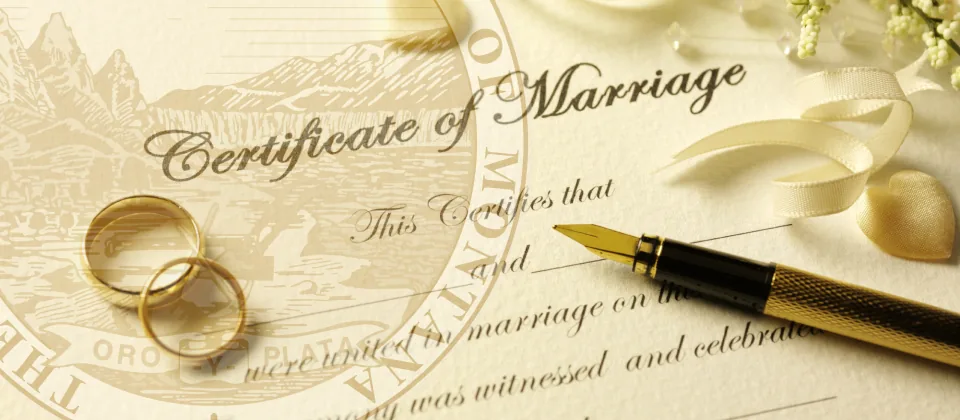
Marriage records are the legal documents that confirm the marriage between two individuals. In general, marriage records contain the full names of both partners, the date of the wedding, the location of the marriage, and the signature of the officiant.
The terms “marriage license,” “marriage certificate,” and “marriage record” are often used interchangeably, but they are not the same. A marriage license is required for pre-wedding authorization to legally marry. A marriage certificate is the document the officiant completes after the wedding and returns to the clerk's office for recording. It proves that the marriage has taken place. However, the marriage record is the complete legal file held by official authorities, in which all necessary documents concerning a marriage are recorded.
The most common reason for a marriage record search is to obtain formal evidence of marital status. Also, these records are needed when changing the name on the driver's license or passport.
Types of Marriage Records in Montana
| Record Type | Purpose | Issued By | Validation/Notes |
|---|---|---|---|
| Marriage license | Gives a couple the authority to marry. | Clerk of the district court. | Valid for 180 days. |
| Marriage certificate | Shows that a marriage was performed and registered. | Clerk of the district court. | Used for name changes and benefits. |
| Marriage record verification | Confirms that a marriage is listed in the state index. | Montana Office of Vital Records. | Only covers a statewide index from July 1943 to the present. |
| Historical marriage records | Used for genealogy and historical research. | County clerk of district court, Montana Historical Society, and FamilySearch. | Includes records dating back to 1864; older files may be on microfilm. |
Marriage Certificates
A marriage certificate issued in Montana is a legal document confirming the marriage between two individuals. It contains information about a wedding ceremony, like the names of the spouses and the officiant, the date of the ceremony, and the witnesses who signed the certificate.
In Montana, this document is issued by the office of the clerk of the district court in the county in which the license was issued. This document serves as legal proof that a marriage took place and is required in many situations, such as changing your name with the Social Security Administration, adding a spouse to health insurance, or resolving estate matters.
Marriage Licenses
This is the application and authorization form, signed and issued to a couple, allowing them to legally marry in Montana. Unlike the marriage certificate issued after a wedding as proof that the marriage took place, a license is a state permit for the couple to wed.
Marriage licenses are obtained from the county clerk's office in the district court. These licenses are valid for 180 days.
Marriage Record Verifications
The vital records office in Montana provides a marriage index search service that verifies the essential facts of a marriage. For individuals who need to prove a marriage occurred, a marriage verification can be useful.
A marriage verification is printed as an informational sheet or confirmation letter, not as a document bearing a raised state seal. The statewide search index provides verification for marriages occurring from July 1943 to the present day.
Are Marriage Records Public in Montana?
Marriage records are partly public in Montana. Under state law, certain information can be released to the public without restriction. These include the spouses' names, ages, and birthplaces; the date and location of the marriage; the parents' names and addresses; the type of ceremony; and the name of the marriage officiant.
However, other information contained in the marriage license application is confidential unless authorized for disclosure by law. Furthermore, Montana law states that information contained in a marriage license and a marriage certificate may be released to the public 30 years after the date of marriage.
What Information Is Included in a Marriage Record?

A Montana marriage record contains detailed information collected during both the application and the ceremony, including:
- Full names of both parties (including maiden names)
- Current birthplaces, dates of birth, and ages
- Current residential addresses of both individuals
- Parents' full names (including mothers' maiden names) and their current addresses
- The number of times each party has been married previously and how those marriages ended
- The date, city, and county where the marriage ceremony took place
- The name and signature of the officiant who performed the ceremony
- The names and signatures of the formal witnesses
It is important to be aware that certain information is not released to the public for security reasons. Examples of such information include Social Security numbers and classified medical or genetic information (which applies to some older records).
How to Find Marriage Records in Montana
Step 1: Identify the Marriage Details
Before beginning a search, collect important information about the marriage. For instance, get the full names of the spouses, including any applicable maiden names. Other critical information includes the marriage date and the county where the marriage took place.
Step 2: Find the Record Custodian
In Montana, the county clerks of the district court are the primary custodians of marriage records. Although the Montana Office of Vital Statistics is a secondary custodian of the records, it does not maintain original certificates; it only provides a comprehensive statewide search index of marriages that occurred in Montana from July 1943 to today.
Some older family marriage records can be found in local county historical archives and with the Montana Historical Society.
Step 3: Choose How to Search
The available search options for a marriage record depend on the local county clerk's office. Some district court clerks offer online forms or electronic applications, while others offer only in-person or mail-order services.
Access to older marriage records is also possible via historical third-party databases, such as FamilySearch and Ancestry. Note that the Montana Historical Society states that Ancestry marriage index collections may be searched in its Reference Room at no cost.
Step 4: Submit a Record Request
Requesters must provide the spouses' names and the marriage date or approximate year. They must also state whether you need an ordinary copy or a certified copy. The clerk's office may also require identification or proof of eligibility to access the record requested. Note that a copy of a marriage license costs $5, while certification costs an additional $2.
How to Get a Certified Marriage Certificate in Montana
To obtain a certified copy of a marriage certificate in Montana, you must file a completed application only with the clerk of the district court in the relevant county where the marriage license was originally issued.
It is important to note that marriage records issued within the last 30 years are confidential, meaning that to request such a record, the requester must be one of the eligible individuals under the law. Such persons include the spouses named on the record, an immediate family member, a legal guardian, an authorized representative, or an individual who can demonstrate that the copy is required to protect a personal or property right.
The process of obtaining the requested record varies slightly from county to county, but district court clerks typically require the requesting party to present a photo ID and record-identifying information.
The state charges a standard fee of $7 to obtain the marriage record, consisting of $5 for the record itself and $2 for certification. The request can be filed in person or by mail, depending on the county where it is filed. Some counties allow online requests for certified marriage certificates. The processing time for a certified marriage certificate varies depending on the county of application, method of request, and age of the record.
How to Get a Marriage License in Montana
Anyone of legal age looking to get married in Montana must first obtain a marriage license from a clerk of the district court. No Montana residency requirement exists under the state's marriage laws, meaning out-of-state residents can obtain a license from any clerk of the district court for use within Montana's borders.
Whether out-of-state or in-state, both applicants for a marriage license must complete and sign the relevant application. At least one of the applicants must appear before the clerk, although some county offices may require both applicants to appear as part of their local procedures. For example, Flathead and Missoula counties require both applicants to appear before the clerk of the district court.
As proof of legal age, Montana permits a birth certificate or other evidence that the clerk deems satisfactory, such as a driver's license, passport, or state ID card. The standard minimum legal age to marry in Montana without special court involvement is 18.
For marriage license applicants who are 16 or 17, the state requires parental or guardian consent and at least two counseling sessions held at least 10 days apart. In addition, the judge must also find that the marriage is in the minor's best interest.
The statutory fee for a marriage license in Montana is $53. However, when neither party will be present at the solemnization, such as in a proxy arrangement, the district court fee states that the marriage license fee is charged at $83. No waiting period is required after obtaining a marriage license; the license becomes effective immediately and expires 180 days later.
A Montana marriage ceremony may be officiated by a judge of a court of record, an authorized public official, a mayor, a city judge, a justice of the peace, an authorized notary public, or a tribal judge. The ceremony may also be performed in accordance with the rites of a religious denomination, an Indian nation or tribe, or a native group.
After the ceremony, the marriage certificate must be filed with the clerk of the district court for registration. The law gives the party responsible for filing the certificate a 30-day period to return the completed certificate.
Who Can Request Marriage Records?
Montana marriage records under 30 years may only be requested by specific eligible persons, such as the following:
- Either individual named directly on the marriage record.
- Immediate family members, such as parents, children, or legal guardians of the spouses.
- Anyone carrying a signed power of attorney or a direct court order granting permission.
- Local, state, or federal entities requiring the record for official verification purposes.
- Legal professionals who can prove the document is necessary to protect their client's personal or property rights.
Anyone outside these categories may only request a marriage record by presenting a certified court order or documentation proving they have a legal right to the file. Members of the public, including genealogists and researchers, can freely access and copy records more than 30 years old.
Free and Online Marriage Record Searches

Certain online platforms offer free access to basic marriage record information, but there are limitations. Free index databases, such as the Western States Marriage Index or FamilySearch Montana Collections, allow the public to look up historical records, names, and event dates.
Note that free online searches only provide index data: the couple's names, the date of the wedding, and the county where it took place. These platforms do not provide access to an official certificate image or a certified document. A paid search through the office of the clerk of the district court is required when a certified copy is needed for legal purposes.
If you are unsure about the county or date of a marriage record, you can mail an application for a search to the Office of Vital Statistics in Montana. For a small fee of $10 per 5-year record search, state workers will find the required record by checking the statewide index for marriage records since 1943.
Common Law Marriage in Montana
Common-law marriages are recognized in Montana. To establish this type of union, couples do not need a marriage license or a wedding ceremony. However, they must:
- Both must be aged at least 18 and must not already be married to someone else
- Mutually agree and have a present intent that they are married to each other
- Cohabit as spouses
- Present themselves to the public as a married couple
Similarly, Montana recognizes common-law marriages established in other states that recognize such unions. Hence, once a common-law marriage is created, it carries the same legal status as a traditional marriage. Therefore, it can only be dissolved through a formal, legal divorce proceeding in court.
To create a paper trail for public records, couples can complete an official Declaration of Marriage Without Solemnization. Montana requires that they sign the document in front of two witnesses and file it with their local clerk of the district court, along with a $53 fee. Subsequently, this document serves as the official public record of their marriage.
How to Correct an Error on a Marriage Record
Errors may occur in a marriage record in the form of mistakes in a name, the date, the place of birth, information relating to the parents of the spouses, ceremony details, and other typographical errors.
Montana outlines specific steps for amending a marriage record. Either spouse named on the marriage certificate is permitted under law to apply to the clerk of the district court that issued the marriage license for a record amendment. The clerk makes the requested changes and forwards the corrected information to the Montana Department of Public Health and Human Services.
Note that the clerk may request certain documents to support the amendment application. However, the documents requested depend on the error. Proofs may include identification, a birth record, a court order, or other documentation establishing the correct information.
In some situations, the correction requested cannot be treated as a simple clerical one. Per state administrative rules, outside specified scenarios, amendments may require the original data provider, a person authorized under the vital records laws, or an order from a court with jurisdiction.
Since corrections are handled locally, processing fees and time vary by county.
Marriage Records and Name Changes
Marriage records are important documents for effecting a name change in government records. Government agencies typically do not accept a standard marriage license or an uncertified copy. Individuals requesting a marriage-based name change must provide a certified copy of their marriage certificate, featuring the court's raised seal.
The following agencies typically require a certified copy of a marriage record for the subject of the record to update their names on file:
- Social Security Administration (SSA): To update the name on a Social Security card.
- Montana Motor Vehicle Division (MVD): To update the name on a driver's license or state ID card.
- U.S. Department of State: To update or reissue a passport with a new name after marriage.
Changing a name on government records after marriage and correcting a marriage record are different processes. It is important to note that, when you submit your marriage certificate as proof of name change to a government agency, it does not amend the name on the marriage certificate itself.
Marriage Records for Genealogy and Family History
Historians and genealogical researchers depend on older marriage records to trace ancestral lines. Historical marriage records allow for this, as they typically list the birthplaces and parents of the bride and groom.
In Montana, early county marriage records date back to 1864. Many of these records are indexed and viewable online via historical volunteer platforms and genealogy sites such as FamilySearch.
However, if you prefer to access actual handwritten record ledgers from the late 1800s or early 1900s, you may contact the local clerk of the district court archives where the wedding was held or the Montana Historical Society Library. The records maintained by this library are stored on microfilm.
When using historical databases, consider searching by the groom's last name alongside the county of the wedding. If that does not yield the desired result, you may look up the bride's maiden name. Furthermore, older marriage records may be incomplete as names were occasionally spelled phonetically by court clerks, and some town records were lost to courthouse fires before modern recordkeeping methods were established.
Frequently Asked Questions
Are marriage records public in Montana?
Basic details such as names and dates are public records, but the marriage certificates are inaccessible to the public for 30 years after the event.
How can I find a marriage record by name?
Older records may be searched by name via online genealogy platforms such as FamilySearch. For recent records, a request may be sent to the Montana Office of Vital Statistics.
Can I search marriage records online for free?
Basic records can be searched for free from online databases, such as FamilySearch and the Western States Marriage Index. The free resources do not provide certified copies.
How much does a marriage certificate cost?
The statutory fee is typically $5 for a marriage license copy and an additional $2 for certification, making a total of $7 for a certified copy. Requests sent to the state office can also attract a $10 fee for each 5-year timeline.
How long does it take to get a certified marriage certificate?
The payment times for requests vary depending on the county. Generally, in-person applications are processed on the same day, while requests submitted by mail take a few weeks to process.
Can someone else request my marriage certificate?
Yes, if the marriage happened over 30 years ago. However, if the marriage is not older than 30 years, then a third party cannot obtain the record unless they are an immediate family member or an authorized representative.
What is the difference between a marriage license and certificate?
A marriage license is the permit that gives couples the right to marry, whereas a marriage certificate is a document that is issued after getting married.
Table of Contents
- Types of Marriage Records in Montana
- Are Marriage Records Public in Montana?
- What Information Is Included in a Marriage Record?
- How to Find Marriage Records in Montana
- How to Get a Certified Marriage Certificate in Montana
- How to Get a Marriage License in Montana
- Who Can Request Marriage Records?
- Free and Online Marriage Record Searches
- Common Law Marriage in Montana
- How to Correct an Error on a Marriage Record
- Marriage Records and Name Changes
- Marriage Records for Genealogy and Family History
- Frequently Asked Questions